August 1998
Despite the efforts of each business, state and local government, and federal agency to race against time and to renovate, validate, and implement their mission-critical information systems every organization remains vulnerable to the disruption of its business processes. Because most federal organizations are highly dependent on information technology to carry out their business, Year 2000-induced failures of one or more mission critical systems may have a severe impact on their ability to deliver critical services. For example:
o The nation's air transportation may face major delays and disruptions because the airlines may not be able to file flight plans with the Federal Aviation Administration.
o Taxpayers may not receive timely tax refunds because the Internal Revenue Service may be unable to process their tax returns.
o Payments to veterans and retirees may be delayed or disrupted by the failure of mission-critical systems supporting the nation's benefit payment systems.
o College students may not receive student education loans promptly.
The risk of failure is not limited to the organization's internal information systems. Many federal agencies also depend on information and data provided by their business partners— including other federal agencies, hundreds of state and local agencies, international organizations, and private sector entities. Finally, every organization also depends on services provided by the public infrastructure—including power, water, transportation, and voice and data telecommunications.
Because of these risks, agencies must have business continuity and contingency plans to reduce the risk of Year 2000 business failures. Specifically, every federal agency must ensure the continuity of its core business processes by identifying, assessing, managing, and mitigating its Year 2000 risks. This effort should not be limited to the risks posed by the Year 2000-induced failures of internal information systems, but must include the potential Year 2000 failures of others, including business partners and infrastructure service providers. One weak link in the chain of critical dependencies and even the most successful Year 2000 program will fail to protect against major disruption of business operations.
The business continuity planning process focuses on reducing the risk of Year 2000-induced business failures. It safeguards an agency's ability to produce a minimum acceptable level of outputs and services in the event of failures of internal or external mission-critical information systems and services. It also links risk management and mitigation efforts to the agency's Year 2000 program, and helps to identify alternate resources and processes needed to operate the agency core business processes. While it does not offer a long-term solution to Year 2000-induced failures, it will help the agency to prepare for a potential crisis, and may facilitate the restoration of normal service at the earliest possible time in the most cost-effective manner.
This guide provides a conceptual framework for helping large agencies to manage the risk of potential Year 2000-induced disruptions to their operations. It provides information on the scope and challenge and offers a structured approach for reviewing the adequacy of agency Year 2000 business continuity and contingency planning efforts.
The guide addresses business continuity and contingency planning issues that are common to most large enterprises. Given the many differences among organizations, we are not prescribing a single, rote approach to business continuity planning. Agencies must tailor their Year 2000 business continuity planning efforts in response to their unique needs while ensuring that the guide's concepts and principles are effectively applied in their business environment to achieve necessary results in the most cost efficient manner.
The guide builds upon our previously issued Year 2000 assessment guide, 1 and draws on a variety of other sources, including research and publications of the Gartner Group, the Disaster Recovery Institute of Canada, the Department of Information Resources for the State of Texas, and the Electrical Engineering Institute of England.
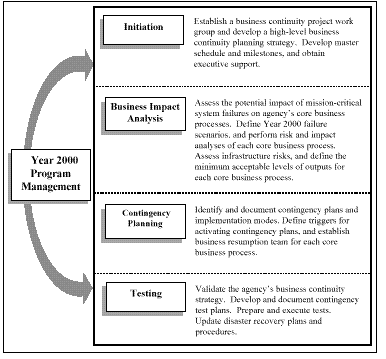
The guide addresses four phases supported by program and project management activities:
o Initiation,
o Business Impact Analysis,
o Contingency Planning, and
o Testing.
In addition to program and project management, the four phases are united by a common theme of accountability at all levels.
If you have any comments or questions about the guide,
please contact us, or E. Randolph Tekeley, Technical
Assistant Director, at (202) 512-4070; or Mirko J.
Dolak, Technical Assistant Director, at (202)
512-6362. We can also be reached by e-mail at
mailto:willemssenj.aimd@gao.gov
mailto:rhodesk.aimd@gao.gov
tekeleye.aimd@gao.gov
dolakm.aimd@gao.gov
An electronic versions of this guide is available from
GAO's World Wide Web server at the following Internet
address:
<http://www.gao.gov/special.pubs/bcpguide.pdf>.
Joel C. Willemssen                     Keith A. Rhodes
Director                               Technical Director
Civil Agencies Information Systems     Office of the Chief Scientist
This guide presents a structured approach to aid federal agencies in business continuity and contingency planning. The guide draws on the work of leading organizations in the information technology industry and incorporates their guidance and practices. Many of the Year 2000-related concepts and practices presented in the guide build upon existing best practices in the contingency and disaster recovery areas.
The guide describes four phases--supported by agency Year 2000 program management--with each phase representing a major Year 2000 business continuity planning project activity or segment.
Year 2000 Business Continuity Planning Structure
1.1 Establish a business continuity project work group
1.2 Develop and document a high-level business continuity planning strategy
1.3 Identify core business processes
1.4 Define roles and assign responsibilities
1.5 Develop a master schedule and milestones
1.6 Implement a risk management process and establish reporting system
1.7 Assess existing business continuity, contingency, and disaster recovery plans and
      capabilities
1.8 Implement quality assurance reviews
The risk of business failure is not limited to the organization's internal information systems, but includes risks associated with the potential failure of embedded microprocessors installed in a wide range of building and industrial process control systems. Many federal agencies also depend on information and data provided by their business partners—including other federal agencies, hundreds of state and local agencies, international organizations, and private sector entities. Finally, every organization also depends on services provided by the public infrastructure--including power, water, transportation, and voice and data telecommunications.
Ensure that individuals responsible for the various business continuity and contingency planning activities are held accountable for the successful completion of individual tasks, and that the core business process owners are responsible and accountable for meeting the milestones for the development and testing of contingency plans for their core business processes.
The quality assurance reviews should examine the worst case scenarios to ensure that a feasible backup strategy--including private sector solutions-- can be successfully implemented in a national emergency.
2.1 Define and document information requirements, methods, and techniques to be used in
developing the business continuity plan
2.2 Define and document Year 2000 failure scenarios
2.3 Perform risk and impact analyses of each core business process
2.4 Assess and document infrastructure risks
2.5 Define the minimum acceptable level of outputs and services for each core business
process
Determine the impact of internal and external information system failures and infrastructure services on each core business process. Consider acquiring business impact analysis tools. These tools will provide consistent analytical structure and processes, and help to standardize the impact analyses throughout the enterprise. For the core business processes and supporting business areas, analyze both manual and automated functional requirements, manual and automated system support requirements, infrastructure support requirements, suppliers, customers, service levels, processing cycles, and the external and internal business drivers. Identify critical functions, recovery priorities and timing, and dependencies to other systems and processes. If a core business process receives data from an external organization, contact that organization and obtain the status of its Year 2000 remediation effort. If there are reasons to be concerned, address these concerns in contingency plans. Estimate the potential cost of service disruptions. In estimating impacts, address the duration of each disruption. Consider using a scorecard to aggregate and track the risk and impact information.
Key Processes
3.1 Assess the cost and benefits of identified alternatives and select the best contingency
strategy for each core business process
3.2 Identify and document contingency plans and implementation modes
3.3 Define and document triggers for activating contingency plans
3.4 Establish a business resumption team for each core business process
3.5 Develop and document "zero day" strategy and procedures
Three important factors in the selection process are
o functionality: the degree to which the replacement functionality supports the production of a minimum acceptable level of output for a given core business process,
o deployment schedule: the time needed to acquire, test, and implement, and
o cost: life-cycle cost, including acquisition, testing, training, and maintenance.
The goal is to maximize the functionality and speed of business resumption.
o quick fix,
o partial replacement,
o full redundancy or replacement, and
o outsourcing to the private sector.
Consider three basic implementation modes for the quick fix, partial, and full replacement of functionality provided by failed mission-critical systems:
o automated replacement,
o semi-automated replacement, and
o manual replacement.
Some core business processes may be fully supported by compliant off-the-shelf application packages that can be purchased and rapidly installed. However, even projects that rely on off-the-shelf replacement packages may fall behind schedules. A semi-automated alternative can implement "bare bones" functionality, using a combination of compliant off-the-shelf applications, such as accounting software or standard database products. A manual alternative normally requires hiring and training of additional staff. While this is not a desirable solution, in some instances it may be used to replace all or part of a failed automated process. Finally, redundant business services may be provided through outsourcing contracts.
o the deployment schedule for each contingency plan and
o the implementation schedule for the renovated or replaced mission-critical systems.
The deployment schedule establishes the date at which the contingency plan must be implemented if is to be to be fully tested before December 31, 1999. For example, if the contingency plan calls for an 8-month deployment schedule, the tentative implementation date should be set for April 30, 1999.
Key Processes
4.1 Validate business continuity strategy
4.2 Develop and document contingency test plans
4.3 Establish test teams and acquire contingency resources
4.4 Prepare for and execute tests
4.5 Validate the capability of contingency plans
4.6 Rehearse business resumption teams
4.7 Update the business continuity plan based upon lessons learned and re-test if necessary
4.8 Update disaster recovery plans and procedures
o test objectives,
o test approach,
o required equipment and resources,
o necessary personnel,
o schedules and locations,
o test procedures, and
o expected results and exit criteria.
o the plan adequately supports a core business function;
o there is adequate capability to manage, record, and track the contingency transactions through the alternative business process;
o the manual activities in particular, and the alternative business process in general, meet an acceptable level of performance;
o an acceptable level of quality control is provided to critical parts of the alternative business process, and an acceptable level of integrity and consistency is provided to alternative databases; and
o an acceptable level of security is provided to the data captured by an alternative data capture mechanism.
o The President's Council on Year 2000 Conversion
http://www.y2k.gov/
o CIO Council Subcommittee on Year 2000
http://www.itpolicy.gsa.gov/mks/yr2000/y201toc1.htm
o MITRE/ESC Year 2000 Homepage
Y2K Contingency Management Plan Outline
http://www.mitre.org:80/research/y2k/docs/CONTINGENCY_PLAN.html
o Federal Deposit Insurance Corporation
Guidance Concerning Contingency Planning
http://www.fdic.gov/banknews/fils/1998/fil9851b.html
General Year 2000 Sites
o The Year 2000 Information Center
http://www.year2000.com
o The Institute for Electrical Engineers in the United
Kingdom
http://www.iee.org.uk/2000risk
Business Continuity and Contingency Planning Sites
o Department of Information Resources for the State of
Texas
Guidelines for Contingency Planning
http://www.dir.state.tx.us/oops/ctgyplan/index.html
o Disaster Recovery Institute of Canada
http://www.dr.org/ppover.htm
o University of Wisconsin - Disaster Management
Center
http://epdwww.engr.wisc.edu/dmc
o Disaster Recovery Journal
http://www.drj.com
o The Journal of Business Continuity
http://www.business-continuity.com/business_continuity.html
the Computer Dictionary: The Comprehensive Standard For Business, School, Library, and Home, Microsoft Press, Washington, D.C., 1991;
The Year 2000 Resource Book, Management Support Technology Corp., Framingham, Massachusetts, 1996;
The Year 2000 and 2-Digit Dates: A Guide for Planning and Implementation, International Business Machines Corporation, 1997;
Denis Howe's "Free On-line Dictionary of Computing," at <http://wombat.doc.ic.ac.uk/>;
and the Gartner Group's "IT Glossary" at <http://gartner5.gartnerweb.com/gartner/itglossary/dlist.html>.
Application
A computer program designed to help people perform a certain type of work. Depending on the work for which it was designed, an application can manipulate text, numbers, graphics, or a combination of these elements.
Architecture
A description of all functional activities to be performed to achieved
the desired mission, the system elements needed to
perform the functions, and the designation of
performance levels of those system elements. An
architecture also includes information on the
technologies, interfaces, and location of functions and
is considered an evolving description of an approach to
achieving a desired
A grouping of business functions
and processes focused on the
production of specific outputs.
Business function
A group of logically related
tasks that are performed together to
accomplish a mission-oriented objective.
Business plan
An action plan that the
enterprise will follow on a short-term and/or
long-term basis. It specifies the strategic and
tactical objectives of the enterprise over a period of
time. The plan, therefore, will change over time.
Although a business plan is usually written in a style
unique to a specific enterprise, it should concisely
describe "what" is planned, "why" it is planned, "when"
it will be implemented, by "whom" it will be
implemented, and "how" it will be assessed. The
architects of the plan are typically the principals of
the enterprise.
Contingency plan
In the context of the Year
2000 program, a plan for responding to
the loss or degradation of essential services due to a
Year 2000 problem in an automated system. In general,
a contingency plan describes the steps the enterprise
would take--including the activation of manual or
contract processes--to ensure the continuity of its
core business processes in the event of a Year
2000-induced system failure.
Infrastructure
The computer and communication
hardware, software, databases,
people, facilities, and policies supporting the
enterprise's information management functions.
Metrics
Measures by which processes,
resources, and products can be
assessed.
Mission-critical System
A system supporting a core
business activity or process.
Portfolio
In the context of the Year 2000
program, an inventory--preferably
automated--of an agency's information systems and their
components grouped by business areas.
Quality assurance
All the planned and
systematic actions necessary to provide
adequate confidence that a product or service will
satisfy given requirements for quality.
Risk assessment
An activity performed to
identify risks and estimate their probability
and the impact of their occurrence; it is used during
system development to provide an estimate of damage,
loss, or harm that could result from a failure to
successfully develop individual system components.
Risk management
A management approach designed
to prevent and reduce risks,
including system development risks, and lessen the
impact of their occurrence.
Strategic IRM plan
A long-term, high-level plan
that defines how the agency will use
information technology to effectively accomplish the
agency's missions, goals, and objectives.
Strategic plan
A long-term, high-level plan
that identifies broad business goals and
provides a roadmap for their achievement.
Test
The process of exercising a product to identify
differences between expected and actual behavior.
Test facility
An environment that partially represents the production
environment but is isolated from it, and is dedicated
to the testing and validation of processes,
applications, and system components.
Validation
The process of evaluating a system or component during
or at the end of the development process to determine
whether it satisfies specified requirements.
Year 2000 problem
The potential problems that might be encountered by
computer hardware, software, or firmware in processing
year-date data for years beyond 2000.
(511469)